

Methylchloroisothiazolinone+Methylisothiazolinone
Hosea Chem® has been supplying Methylchloroisothiazolinone+Methylisothiazolinone (CAS 26172-55-4) (CAS 2682-20-4) with high quality and competitive price for many years, covering most of the European, American, middle east, etc. Send Inquiry
Product Description
Methylchloroisothiazolinone+Methylisothiazolinone [ CMIT + MIT ]
Preservative, Mildew-Proof, Antibacterial, Bactericidal, Algaecidal, and Water Treatment Product Series.
CMIT/MIT (Kathon) isothiazolinone bactericides.
Specification of Product
Product Name : Methylchloroisothiazolinone+Methylisothiazolinone
CMIT/MIT
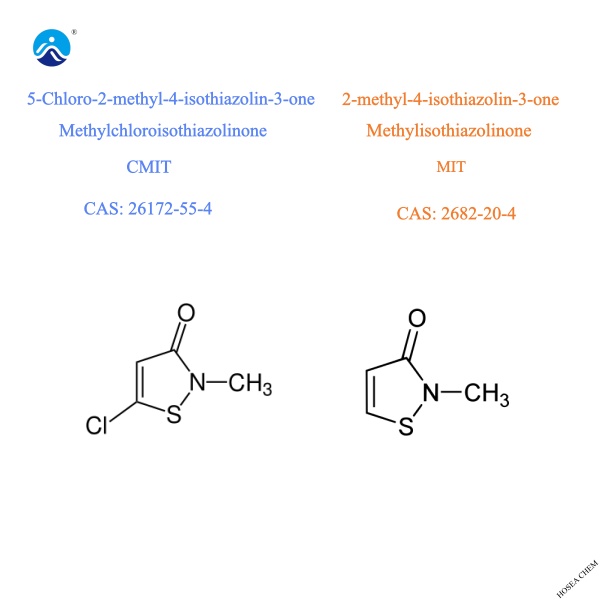
5-Chloro-2-methyl-4-isothiazolin-3-one + 2-methyl-4-isothiazolin-3-one


CAS No.: 26172-55-4 CAS No.: 2682-20-4
EINECS No.: 247-500-7 EINECS No.: 220-239-6
Molecular Formula: C4H4ClNOS Molecular Formula: C4H5NOS
Molecular Weight: 149.59 Molecular Weight: 115.1
Methylchloroisothiazolinone (CMIT) + Methylisothiazolinone (MIT) type
| Product Model | Active Ingredient Concentration | Core Stabilizer/Solvent | CMIT:MIT Ratio | Core Features | Compatibility | Applicable pH/Temperature Resistance |
|---|---|---|---|---|---|---|
| CMIT/MIT-14% Divalent | 14% | Divalent metal salts (Mg/Ca/Cu) | Classic 3:1 | Industrial general-purpose type with the highest cost performance | Moderate; prone to salting out with emulsions/dispersions | 2.0-8.0 / ≤50℃ |
| CMIT/MIT-14% MV Monovalent | 14% | Monovalent metal salts (K/Na) + anti-sediment agent | Classic 3:1 | Improved metal salt type, MV as the exclusive model designation | Excellent; no salting out caused by secondary divalent ions | 2.0-9.0 / ≤60℃ |
| Salt-Free Kathon PG10 | 10% | Propylene glycol (PG) + alcohol stabilizer, no metal salts | Classic 3:1 | Low-concentration salt-free basic type, alcohol-soluble and stable | Excellent; compatible with all systems without precipitation | 2.0-9.5 / ≤65℃ |
| Salt-Free Kathon PG14 | 14% | Propylene glycol (PG) + alcohol stabilizer, no metal salts | Classic 3:1 | High-concentration salt-free mainstream type, balancing activity and compatibility | Excellent; compatible with all systems without precipitation | 2.0-9.5 / ≤65℃ |
| Salt-Free Kathon DPG14 | 14% | Dipropylene glycol (DPG) + alcohol stabilizer, no metal salts | Classic 3:1 | High-concentration salt-free premium type, milder DPG solvent | Excellent; compatible with all systems, low irritation | 2.0-10.0 / ≤70℃ |
| Reverse Ratio CMIT/MIT-CM10 | 10% | Alcohol stabilizer, salt-free | Reverse 1:3 (high MIT ratio) | Special reverse ratio type, MIT-dominated with excellent mildness | Excellent; compatible with all systems | 2.0-9.0 / ≤60℃ |
Methylchloroisothiazolinone+Methylisothiazolinone (CMIT/MIT) Applications
1. Metal Salt Stabilized Type (Divalent / Monovalent MV) – Industrially Applicable, Cost-Effective
This is the most traditional Kathon formulation, relying on metal ions to inhibit CMIT/MIT decomposition, ensuring activity stability. The presence of metal ions is its core characteristic and the essential difference from the salt-free type.
1.1 CMIT/MIT 14% Divalent
Core Advantages: Lowest price, strong industrial versatility, 14% high activity meets most corrosion protection needs;
Core Disadvantages: Divalent metal ions (Mg²+/Ca²+) easily form salt clusters/agglomerates with aqueous emulsions and acrylate dispersions, leading to system stratification and precipitation, suitable only for simple systems;
Applicable Scenarios: Industrial circulating water, oilfield injection water, papermaking white water, ordinary detergents, cement mortar, and other non-emulsion type simple aqueous systems.
1.2 CMIT/MIT 14% MV Monovalent
Core Advantages: Eliminates divalent metal salts; monovalent ions (K+/Na+) reduce salt cluster risk at the source, offering far superior compatibility compared to the divalent type, while maintaining 14% high activity and cost-effectiveness.
Core Disadvantages: Still contains metal ions; a very small number of ion-sensitive precision systems (such as high-end electronic cleaning agents) may still experience slight impact.
Applicable Scenarios: Suitable for moderately complex water-based systems such as ordinary latex paints, basic water-based adhesives, mid-range metal cutting fluids, and textile printing and dyeing solutions. It is a direct upgrade from the divalent type.
2. Salt-Free Alcohol-Stable Type (PG10/PG14/DPG14) – Compatible with All Systems, Preferred for High-End Applications
Completely eliminates all metal salts, using propylene glycol (PG)/dipropylene glycol (DPG) as solvent and stabilizer. This is currently the mainstream improved version of Kathon, with salt-free and ion-free properties as its core advantages, solving all compatibility issues at the source. It is also the preferred choice for high-end water-based systems such as coatings, emulsions, and adhesives.
2.1 Salt-Free Kathon PG10 (Salt-Free, 10%)
Core Advantages: Low concentration + salt-free, cost between metal salt type and high concentration salt-free type, alcohol-soluble and stable, no risk of precipitation/salt clusters;
Core Disadvantages: 10% active ingredient concentration requires increased addition to achieve the preservative effect of a 14% product, suitable for small-batch, low-preservative-demand scenarios;
Applicable Scenarios: Small-scale daily chemical formulations, low-concentration water-based additives, laboratory sample preparation, cost-sensitive but salt-free lightweight systems.
2.2 Salt-Free Kathon PG14 (Salt-Free, 14%)
Core Advantages: 14% high activity + salt-free + propylene glycol solvent, balancing preservative efficiency and overall system compatibility. It is the mainstream salt-free Kathon formulation, offering the best balance between cost-effectiveness and applicability.
Core Disadvantages: Propylene glycol solvent has a slight irritant effect; optimization is needed for applications requiring extremely high skin feel/mildness.
Applicable Applications: Mid-to-high-end water-based emulsions/latex paints, polymer dispersions, water-based adhesives/sealants, high-end metal cutting fluids, environmentally friendly daily chemical additives, etc. It is currently the most widely used salt-free Kathon formulation.
2.3 Salt-Free Kathon DPG14 (Salt-free, 14%)
Core Advantages: Using dipropylene glycol (DPG) as a solvent, DPG is gentler, less irritating, and more skin-friendly than PG, with superior pH and temperature resistance (pH up to 10.0, temperature resistance up to 70℃). Its salt-free nature ensures compatibility across all systems.
Core Disadvantages: Highest price; DPG solvent costs more than PG.
Suitable Scenarios: High-end daily chemical formulations (such as shampoos and shower gels), water-based cosmetics with high skin feel requirements, precision electronic cleaning agents, high-pH water-based systems (such as alkaline coatings/adhesives), and other scenarios requiring extreme gentleness and compatibility.
3. Reverse Chlorine Ratio Type (CM10) – Prioritizing Mildness, Targeted Sterilization
This is a special formulation of a salt-free, alcohol-stabilized type. The core difference lies in the chlorine ratio (CMIT:MIT = 1:3), the opposite of the classic 3:1. MIT (2-methyl-4-isothiazolin-3-one) is the primary active ingredient, with CMIT as a secondary component.
Core Advantages: MIT has a bactericidal spectrum biased towards mold/yeast, and its gentleness is far superior to CMIT (CMIT is the main source of irritation). After the dechlorination ratio, overall irritation is significantly reduced, and it is salt-free and compatible with all systems.
Core Disadvantages: With an active ingredient concentration of 10% and a low CMIT content, its bactericidal efficiency against bacteria (such as E. coli and Staphylococcus aureus) is slightly lower than the classic 3:1 ratio.
Suitable Scenarios: Systems primarily contaminated with mold (such as latex paint, water-based coatings, and wood preservatives), daily chemical/light industrial systems requiring high gentleness (such as facial masks and water-based skincare products), and water-based formulas that need to balance bactericidal action and skin feel.
Key Commonalities: General Precautions for All Products
1. All are broad-spectrum bactericides, effective against bacteria, molds, and yeasts, differing only in their bactericidal spectrum focus (CM10 is more effective against molds, while the classic 3:1 is more effective against bacteria);
2. All should not be mixed with strong reducing agents, amines, thiols, or nucleophiles, as this will cause rapid degradation of the active ingredients and loss of preservative effect;
3. All are designed for aqueous systems only and cannot be used directly in oily systems; they require dispersion with an emulsifier;
4. The recommended addition amount is 0.05%-0.4% (based on the total formulation). Higher concentration products (14%) require even lower addition amounts, while lower concentration products (10%) require appropriately higher amounts.