

NEW PRODUCTS
Cellulose acetate butyrate
Hosea Chem® has been supplying Cellulose acetate butyrate (CAS 9004-36-8) with high quality and competitive price for many years, covering most of the European, American, middle east, etc. Send Inquiry
Product Description
Cellulose acetate butyrate
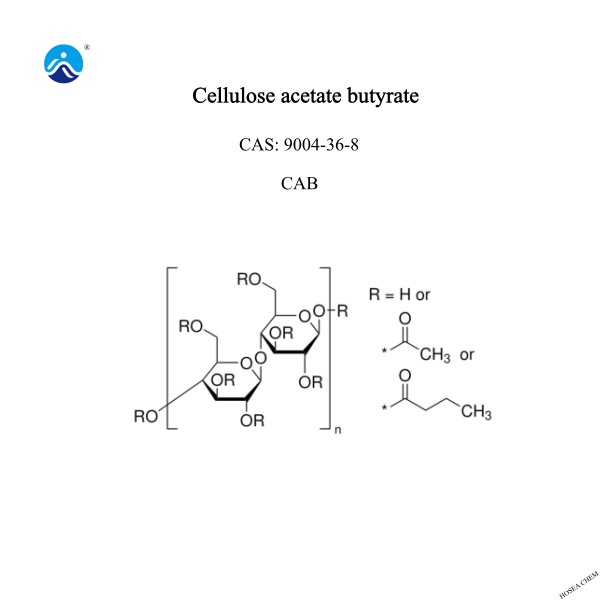
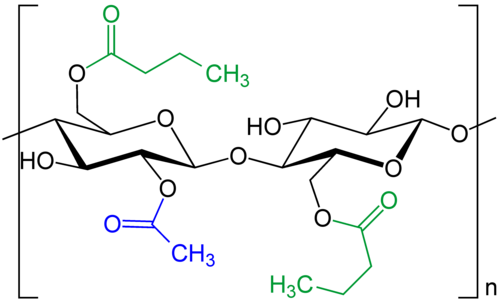
Cellulose acetate butyrate (CAB) is a semi-synthetic polymer, typically produced by reacting cellulose with acetic acid and butyric anhydride. In this compound, the hydroxyl groups of cellulose are replaced by acetic acid and butyrate groups. Cellulose acetate butyrate exhibits excellent weather resistance, chemical stability, solvent resistance, solubility, flowability, and moldability, as well as high heat resistance and mechanical strength. It is widely used in various fields, including plastics, coatings, inks, adhesives, optical films, and packaging materials.
Specification of Product
Product Name : Cellulose acetate butyrate
CAB
CAS No.: 9004-36-8
Cellulose acetate butyrate specification
From the perspective of mainstream product grades, the mainstream grades of cellulose acetate butyrate are the 381 series, such as 381-0.1, 381-0.5, 381-2, etc.; the 551 series, such as 551-0.2, 551-0.01, etc.; and other grades such as 531-1.
CAB381-0.1: Low solution viscosity. Suitable for coatings on wood, metal, plastics, paper, leather, and fabrics. It can reduce cratering, shorten dry contact time, and improve pigment control and intercoating adhesion.
CAB381-0.5: Higher viscosity, increased toughness. A good balance between compatibility and viscosity; it is soluble in many solvents and homomiscible with many resins, making it unique and important in the coatings industry.
CAB381-2: Higher viscosity, increased toughness, and good surface hardness. Suitable for automotive base coats; it can improve the orientation of flake metallic pigments.
CAB-551-0.2: Used in printing inks, it can reduce pinholes, improve flow and heat reflow, reduce surface adhesion, and reduce surface spots.
Cellulose acetate butyrate Applications
In the coatings industry: Cellulose acetate butyrate can be used as a film-forming aid in various coatings, including automotive paints, wood coatings, and metal paints. It effectively improves the drying speed of coatings, enhances the hardness, gloss, and water resistance of the coating, making the paint surface more wear-resistant and less prone to fading.
In the ink industry: Used in gravure inks and flexographic inks, it enhances the adhesion of inks to different substrates (such as plastics and paper), making printed patterns clearer and colors more vibrant. It also improves the flowability and drying performance of inks, increasing printing efficiency.
In the plastics industry: As a modifying additive for plastics, it improves the flexibility, impact resistance, and weather resistance of plastics. It is commonly used in the manufacture of plastic products such as eyeglass frames, pen barrels, and electronic device casings, giving products better texture and durability.
In motion picture film and audio/video tapes: Due to its excellent film-forming properties and stability, it was widely used in the production of motion picture film bases and early audio/video tapes, ensuring the stability and durability of image and sound recordings.
Cellulose acetate butyrate Storage:
It should be stored in a cool, dry, and well-ventilated warehouse, avoiding direct sunlight and rain. The storage temperature should be controlled between 5 and 30℃, and the relative humidity should not exceed 65%. Keep away from fire and heat sources, and store separately from oxidizers, acids, and alkalis to prevent chemical reactions. The products should be stacked neatly and not too high to avoid deformation under pressure, and the first-in, first-out principle should be followed.
Cellulose acetate butyrate Packaging
25 Kgs/Bag, Packaging should be done in polypropylene woven bags or paper-plastic composite bags lined with polyethylene film. The packaging must be airtight to prevent moisture and impurities from entering during transportation and storage.